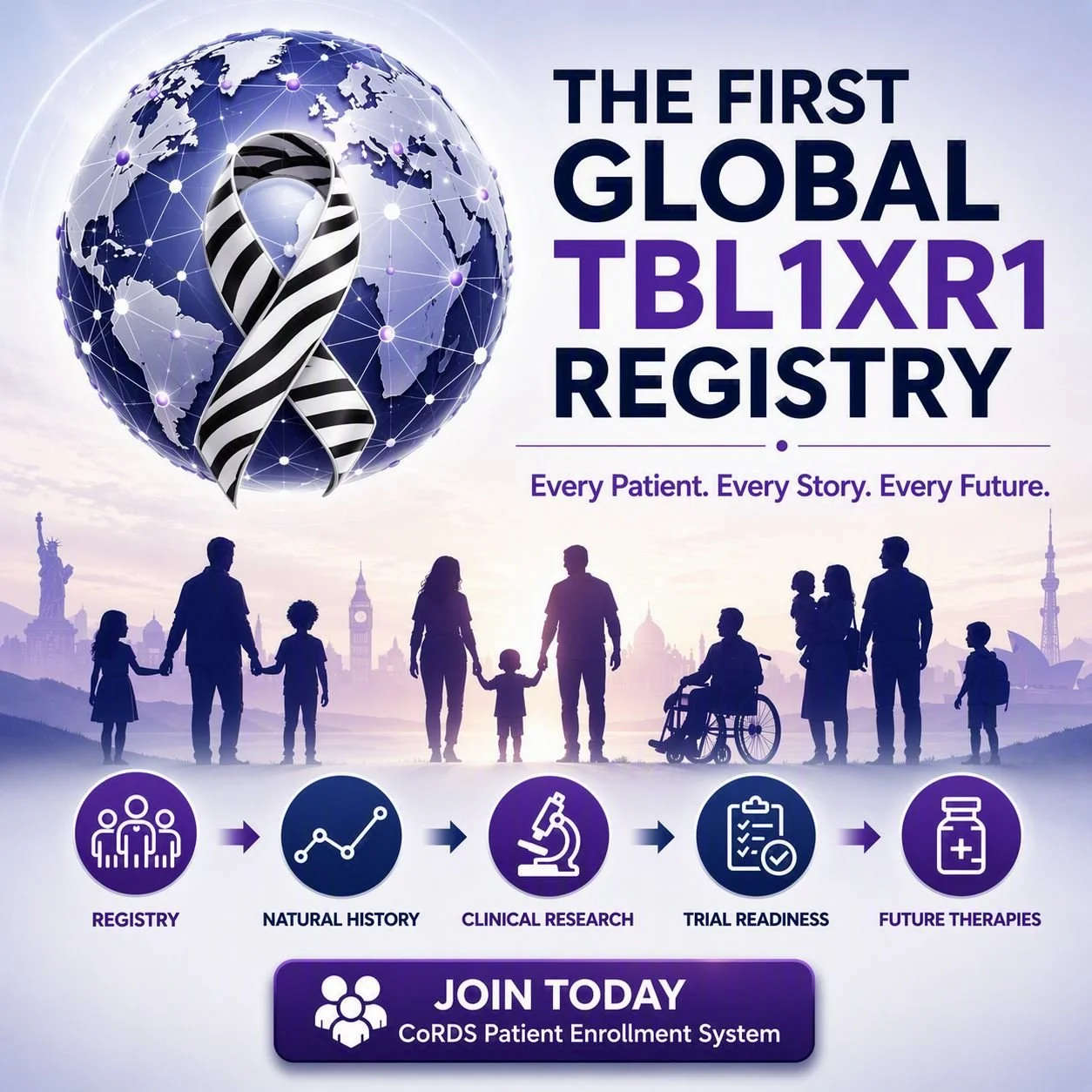

For the first time, families affected by TBL1XR1-related disorders around the world have the opportunity to contribute to a single, international registry designed to advance research and prepare the path toward future therapies.
Why does this matter?
Before new treatments can be developed, researchers first need to understand the condition. They need to know:
· How many individuals are affected worldwide
· How symptoms vary from person to person
· How the condition changes over time
· What challenges families face every day
The Global TBL1XR1 Registry will help answer these questions and create the foundation for future natural history studies, clinical research, and trial readiness.
The survey is comprehensive because every aspect of a patient's experience matters. The more we learn about the TBL1XR1 community, the better equipped researchers will be to develop meaningful interventions in the future.
This is more than a survey. It is the foundation for the future of TBL1XR1 research.
How to Participate
· Access the registry: CoRDS Patient Enrollment System - Activation Form
· Instructions on how to fill it out: Participant Portal-Activation | Videos & Movies on Vimeo
· Fill in the questionnaire at your own pace. You can save and submit it later.
· Submit your responses.
· Share the registry with other TBL1XR1 families, clinicians, and advocacy groups.
Why Your Participation Matters
· Every patient strengthens the dataset.
· Every family contributes valuable knowledge.
· Every registration helps make TBL1XR1 more visible to researchers and future partners.
· Every data point brings us closer to better understanding, clinical studies, and ultimately therapies.
No patient is too young, too old, too mildly affected, or too severely affected. Every story matters. Every patient counts.
Join the First Global TBL1XR1 Registry today:
CoRDS Patient Enrollment System - Activation Form
Together, we can build the global foundation for TBL1XR1 research and future treatments.